Submitted by bing-yan 285 AskChem: Claim-Centered Infrastructure for Chemistry Literature Synthesis New York University 5 2
Submitted by kongquyu 274 Qwen-UI-Agent Technical Report: Toward Next-Generation Real-World Centric Foundation GUI Agents TongyiLab 6
Submitted by iseesaw 159 Frontis-MA1: Training an AI4AI Model towards Recursive Self-Improvement in Machine Learning Engineering Frontis AI 72 2
Submitted by taesiri 151 PhiZero: A World Model Built Around Physical Language Chinese Academic of Science Institute of Automation 23 3
Submitted by Lin-Chen 62 VideoCoCo: Code-as-CoT for Physically-Consistent Video Generation via an Agentic Dual-Engine System · 28 authors 55 2
Submitted by Rubin-Wei 48 Memory Decoder at Scale: A Pretrained, Parametric Long-Term Memory · 7 authors 6 2
Submitted by DogNeverSleep 45 Beacon: Knowing When and How to Perform Agentic Visual Reasoning Kling Team 2 2
Submitted by Bstwpy 40 BM25 Wins at Scale: A Scaling Study of Retrieval-Augmented Generation Paradigms muset.ai 4
Submitted by Ayanami0730 36 MPIE-Bench: Benchmarking Anatomically Plausible Multi-Person Interaction Editing muset.ai 3 2
Submitted by taesiri 34 ACE-Data-0: Human-Centric Ambient Capture as Embodied Data Engine · 16 authors 1
Submitted by Ayanami0730 30 Beyond Borrowed Histories: Person-Aligned User Simulation for Interactive Role-Playing Evaluation muset.ai 4 2
Submitted by DogNeverSleep 24 RefCaptioner: Multi-Reference Image-Grounded Video Captioning Kling Team 3 2
Submitted by Yang-Zhou 21 SpatialCLI: Learning to Reason With Spatial Tools, Then Without Them · 13 authors 8 2
Submitted by SiyuYanYan 21 See2Think: Do Multimodal Models Really Use Intermediate Visual States? · 13 authors 3 2
Submitted by minghuiliu 17 β-OPSD: Deriving with Policy Optimization, Training with Self-Distillation Furong Huang's Lab at UMD 2
Submitted by taesiri 16 Chimera: Designing and Chinchilla-Scaling Hybrid Visual Diffusion Transformers Adobe 1
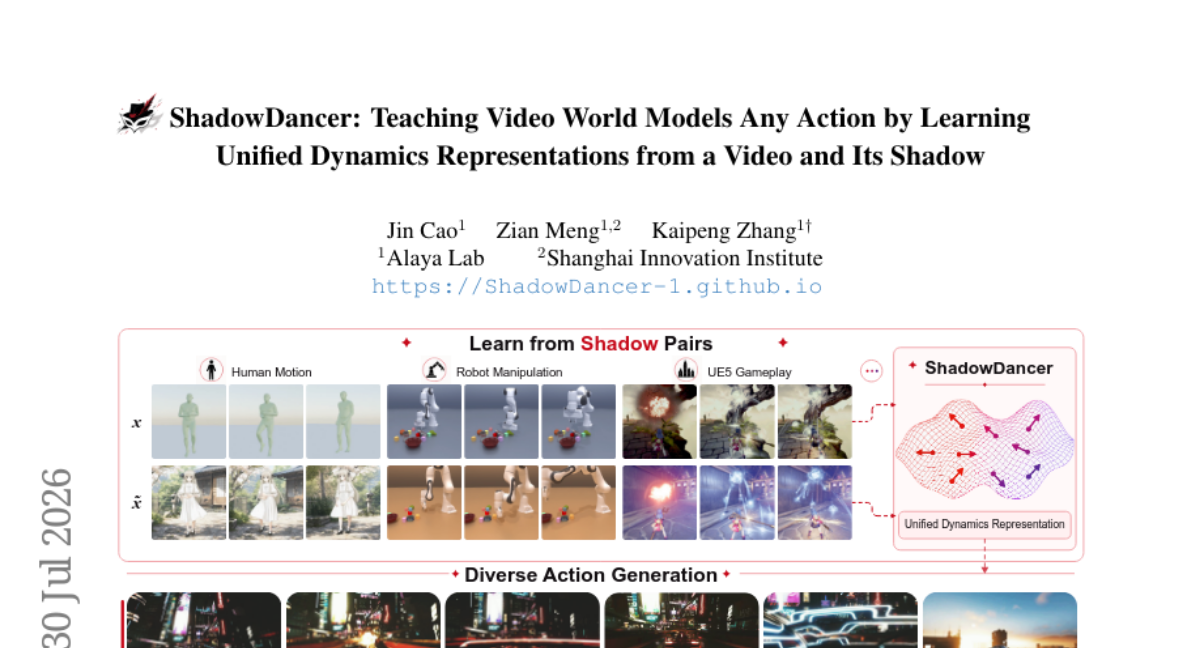
Submitted by kpzhang996 16 ShadowDancer: Teaching Video World Models Any Action by Learning Unified Dynamics Representations from a Video and Its Shadow Alaya Lab 18 3
Submitted by Edaizi 13 MemHarness: Memory Is Reconstructed, Not Replayed KnowledgeXLab@Shanghai AI Lab 4 2
Submitted by DavidSunok 12 INTACT: Isomorphic Intent-to-Action Learning for Search-Free World Models Zhejiang University 58 3
Submitted by EnjunDu 9 LEDGERMIND: Provenance-Constrained Multimodal Agentic Reasoning with a Structured Evidence Ledger · 7 authors 2
Submitted by akshaynambi 9 Echoverse: Deep, Evolving Environments for Training Computer-Use Agents at Scale Microsoft Research 11 2
Submitted by Jackbrocp 8 Σ-Mem: An Online Reliability Memory for LLM-based Multi-Agent Systems Nanyang Technological University 2
Submitted by alexiglad 8 Explorative Modeling: Unlocking a Third Pretraining Axis and End-to-End Generation University of Illinois at Urbana-Champaign 43 2
Submitted by KevinSRR 6 Filesystem-Based Memory for LLM Agents: Organization, Evolution, and Sustainability · 11 authors 2
Submitted by kinneso 4 Revisiting Lossy Verification in Speculative Decoding: Mechanisms, Trade-offs, and Failure Modes · 6 authors 2 2
Submitted by Consonnm 3 OmniScope: Modality-Decoupled Token Compression for Omnimodal Large Language Models · 6 authors 3 2
Submitted by whfeLingYu 3 Is Deep Research Reliable? Misleading Knowledge Induces False Conclusions · 4 authors 2
Submitted by Huiyuancs 2 Beyond Geometric Complementarity: Coherent Overlap in Sparse Mixture-of-Experts Routing · 3 authors 2
Submitted by taesiri 2 ReToken: One Token to Improve Vision-Language Models for Visual Retrieval · 6 authors 2 1
Submitted by oopere 2 Fairness Pruning: Locating Demographic Bias in GLU-MLP Layers via Differential Activations · 3 authors 3
Submitted by dlion168 - AMRD: Adaptive Multi-Teacher Relational Distillation for Lightweight Speech Emotion Recognition · 8 authors 2
Submitted by jub-aer - Pedestrian Archetypes Extension -- More Pedestrian Models for Autonomous Vehicle Safety Testing · 9 authors 2


 bing-yan