

user stringlengths 18 696 | CoT stringlengths 150 1.47k | assistant stringlengths 1 1.5k |
|---|---|---|
Write a SQL query to find the second highest salary from an Employee table. | Let me check the standard way to rank salaries without using LIMIT, since ties matter. Actually a subquery with MAX works: find the max salary that is less than the overall max. Wait, if the top salary repeats, that still gives the next distinct value. Let me verify: WHERE salary < (SELECT MAX(salary) FROM Employee) th... | SELECT MAX(salary) AS SecondHighestSalary
FROM Employee
WHERE salary < (SELECT MAX(salary) FROM Employee); |
Write a CSS snippet to create a responsive 3-column grid layout. | CSS grid placement is driven by explicit track definitions, so I start with three fractional columns. The minmax function keeps each column from collapsing below a readable width. Wait, fixed fractions alone would overflow on narrow screens. Actually auto-fit with minmax lets the grid reflow to fewer columns automatica... | .grid {
display: grid;
grid-template-columns: repeat(auto-fit, minmax(250px, 1fr));
gap: 1rem;
} |
Explain the role of a 'Load Balancer' in a high-traffic web application. | A load balancer sits in front of multiple servers and receives all incoming requests. It then distributes those requests across the server pool using algorithms like round-robin or least connections. Wait, if one server fails, the load balancer must detect that and stop sending traffic to it. Actually, health checks ar... | A load balancer acts as a reverse proxy that distributes incoming network traffic across multiple backend servers. In a high-traffic web application, it prevents any single server from becoming a bottleneck by spreading requests evenly, which improves responsiveness and uptime. It also performs health checks to route t... |
What is the difference between TCP and UDP protocols? | TCP and UDP are both transport layer protocols, but they handle data transmission differently. TCP establishes a connection and ensures all packets arrive in order with error checking. UDP sends packets without establishing a connection, so it's faster but less reliable. Wait, TCP also has flow control and congestion c... | TCP (Transmission Control Protocol) is connection-oriented, reliable, and ensures ordered delivery of data with error checking and retransmission. UDP (User Datagram Protocol) is connectionless, unreliable, and does not guarantee order or delivery, but is faster and has lower overhead. TCP is used for applications like... |
How do REST APIs differ from GraphQL? | REST exposes fixed endpoints that return predefined shapes, so clients often over-fetch or under-fetch data. GraphQL exposes a single endpoint where clients specify exactly which fields they need. Wait, that flexibility shifts complexity to the server, which must resolve nested queries efficiently. Let me check: REST r... | REST APIs expose multiple endpoints, each returning a fixed data structure, and rely on HTTP methods (GET, POST, PUT, DELETE) and status codes. GraphQL exposes a single endpoint where clients send queries specifying exactly the fields they need, avoiding over-fetching and under-fetching. REST is simpler to cache and ev... |
Explain the difference between supervised and unsupervised learning. | Supervised learning relies on labeled data, where each input has a known output. The model learns by comparing its predictions to these labels and adjusting to minimize error. Unsupervised learning, on the other hand, works with unlabeled data, so there's no ground truth to guide the learning. Instead, it seeks to find... | Supervised learning uses labeled data to train models to predict outputs for new inputs, while unsupervised learning uses unlabeled data to discover hidden patterns or intrinsic structures. In supervised learning, the goal is to learn a mapping from inputs to outputs based on example input-output pairs. Common tasks in... |
How does a hash table resolve collisions? | A hash function can map different keys to the same index, so I need a way to store more than one entry per slot. Wait, if I just overwrite, data is lost, so the structure has to track multiple items per bucket. Actually, the two common approaches are separate chaining and open addressing. Let me check: chaining uses li... | A hash table resolves collisions mainly through two strategies: separate chaining and open addressing. In separate chaining, each bucket holds a linked list (or sometimes a tree) of all entries that hash to the same index; lookup scans that list. In open addressing, all entries are stored in the table itself, and when ... |
What is 'Reinforcement Learning from Human Feedback' (RLHF)? | The model's output distribution needs to be shaped by something beyond log-likelihood, because human preferences are not directly differentiable. Wait, we can't backprop through a human's judgment. Actually, we train a separate reward model on pairwise comparisons, then use that as a differentiable proxy. Let me check:... | Reinforcement Learning from Human Feedback (RLHF) is a technique for fine-tuning AI models, especially large language models, using human preferences as the reward signal. It typically involves three stages: (1) supervised fine-tuning on demonstrations, (2) training a reward model on human comparisons of model outputs ... |
Explain the difference between a process and a thread in operating systems. | A process is a program in execution with its own address space and resources, so it's heavy to create and switch. Threads are units of execution within a process, sharing memory and resources but having their own stack and registers. Let me check: the key distinction is isolation versus sharing. Actually, threads enabl... | A process is an independent program in execution, with its own address space, memory, file handles, and other resources. A thread is a smaller unit of execution within a process; multiple threads share the process's address space and resources but have their own stack, registers, and program counter. Processes are isol... |
How does a virtual private network (VPN) encrypt traffic? | A VPN creates a secure tunnel by wrapping each data packet inside an encrypted outer packet. The encryption key is established through a handshake, often using public-key cryptography to share a symmetric session key. Wait, the actual data encryption then uses that symmetric key because it's much faster for bulk traffi... | A VPN encrypts traffic by creating a secure tunnel between your device and a VPN server. When you send data, the VPN client intercepts each packet and encrypts its payload using a symmetric encryption algorithm (like AES) with a session key. That session key is typically established through a secure handshake using asy... |
What is the purpose of garbage collection in programming languages like Java? | I know that in languages like Java, objects are created dynamically on the heap, and without cleanup, memory would fill up. The garbage collector automatically identifies objects that are no longer reachable from any live thread or static reference. It then reclaims that memory so it can be reused for new allocations. ... | Garbage collection automatically reclaims heap memory occupied by objects that are no longer reachable or needed by a program. Its main purposes are to prevent memory leaks, avoid manual deallocation errors, and allow safe reuse of memory, which simplifies development and improves program reliability. |
Describe the concept of 'Few-Shot Prompting'. | Few-shot prompting works by feeding the model a handful of input-output pairs before the actual query. The model then infers the pattern from those examples and applies it to the new input. Wait, zero-shot gives no examples, and one-shot gives just one, so few-shot is the middle ground. Actually, more examples can help... | Few-shot prompting is a technique where you provide a large language model with a small number of demonstration examples (typically 2–5) of the desired input-output behavior directly in the prompt, before asking it to perform the same task on a new input. The model uses these examples as in-context learning to infer th... |
Compare 'Dense' models with 'MoE' (Mixture of Experts) models. | Dense models activate all parameters for every input, so compute scales linearly with parameter count. MoE models route each token to only a subset of experts, meaning total parameters can be huge while active parameters per token stay small. Wait, that means MoE can have more capacity without a proportional increase i... | Dense models use all parameters for every input, offering simplicity and predictable compute but scaling cost linearly with size. MoE models activate only a subset of experts per token, enabling much larger total parameter counts with lower per-token compute, but introduce routing complexity, load-balancing challenges,... |
How does the 'Transformer' architecture differ from traditional RNNs? | RNNs process tokens one at a time, so the hidden state carries all past information sequentially. That makes long-range dependencies hard to learn because gradients must flow through many steps. Transformer replaces recurrence with self-attention, letting every position attend to every other position in parallel. Let m... | The Transformer differs from traditional RNNs in three main ways:
1. **Parallel processing**: RNNs process sequences step-by-step, so they cannot parallelize across time steps. Transformers process all positions simultaneously using self-attention, which makes training much faster on modern hardware.
2. **Long-range ... |
Write a Python script to automate the backup of a specific folder to an AWS S3 bucket. | I need to create a script that uploads a folder to S3. Let me check the best way to handle this: using boto3 with a recursive upload is straightforward. Wait, I should also consider error handling and maybe compression. Actually, for simplicity, I'll use the upload_file method in a loop over files. Let me check: boto3'... | import os
import argparse
import boto3
from botocore.exceptions import ClientError
def upload_folder_to_s3(folder_path, bucket_name, s3_prefix=''):
"""Upload all files in a folder to an S3 bucket."""
s3_client = boto3.client('s3')
for root, dirs, files in os.walk(folder_path):
for filename in files... |
Explain 'Tokenization' and how it handles different languages. | Tokenization splits text into smaller units, often subwords, to balance vocabulary size and meaning. For different languages, it must handle scripts without spaces, like Chinese, by learning frequent character pairs. Actually, byte-level fallbacks prevent unknown characters in any script. Let me check: agglutinative la... | Tokenization is the process of breaking text into smaller units called tokens, which can be words, subwords, or characters, so a model can process them numerically. It handles different languages by using algorithms like Byte-Pair Encoding (BPE) or SentencePiece that learn frequent subword units from raw text. For lang... |
Describe the function of the 'Docker Daemon' and how it interacts with the CLI. | The daemon is the long-running process that actually builds, runs, and manages containers. The CLI is just a thin client that sends commands over a REST API or Unix socket. Wait, the CLI doesn't do any container work itself. Actually, the daemon listens for API requests and executes them. Let me check: when you type do... | The Docker Daemon (dockerd) is the persistent background service that does the actual work: building images, creating and running containers, managing volumes, networks, and pulling/pushing images to registries. The Docker CLI (docker) is a client that translates user commands into REST API calls, which it sends to the... |
How can 'Distillation' help a 3B model perform like a 70B model? | A small model can't discover all the patterns a huge model has seen, so the big model's output distribution carries extra signal. Wait, matching only hard labels loses the relative probabilities between wrong answers. Actually the softmax with a temperature gives a richer target, so the small model learns which mistake... | Knowledge distillation trains the small (student) model to match the large (teacher) model's full output distribution—usually softened logits—rather than just hard labels. The teacher's soft probabilities encode similarity structure among classes/tokens (e.g., 'cat' is closer to 'dog' than to 'car'), which acts as a ri... |
What is a buffer overflow attack and how can it be prevented? | A buffer overflow happens when a program writes more data to a fixed-size memory buffer than it can hold, spilling into adjacent memory. This can overwrite control data like return addresses, letting an attacker redirect execution to malicious code. The root cause is missing bounds checking on input or copy operations.... | A buffer overflow attack occurs when a program writes more data to a fixed-length buffer than it can hold, causing adjacent memory to be overwritten. Attackers exploit this to corrupt control flow, inject shellcode, or crash the system. Prevention includes: using memory-safe languages or safe string functions (e.g., st... |
How does 'Temperature' affect the randomness of LLM outputs? | Temperature scales the logits before the softmax, so it directly changes the probability distribution over the next token. Wait, it doesn't touch the model weights at all, just the sampling step. Actually, a lower temperature sharpens the distribution toward the most likely tokens, while a higher one flattens it. Let m... | Temperature controls the shape of the probability distribution over the next token before sampling. It divides the model's raw logits by a scalar T before applying softmax:
P(token_i) = exp(logit_i / T) / Σ_j exp(logit_j / T)
- **T < 1 (e.g., 0.2–0.7):** Sharpens the distribution. High-probability tokens become even ... |
Explain the significance of 'P vs NP' in computer science. | P vs NP asks whether every problem whose solution can be checked quickly can also be solved quickly. Let me check: 'quickly' means polynomial time in the input size. Actually, many practical problems like scheduling and protein folding are in NP but no fast algorithm is known. If P equals NP, then hard search problems ... | P vs NP is the central open problem in theoretical computer science. It asks whether every problem whose solution can be verified in polynomial time (NP) can also be solved in polynomial time (P). If P = NP, then efficient algorithms exist for thousands of practical problems like scheduling, route planning, and protein... |
What are the main differences between relational and NoSQL databases? | Relational databases enforce a fixed schema and use SQL with ACID transactions, while NoSQL databases trade strict consistency for flexible schemas and horizontal scaling. The core difference comes from how they handle data relationships: relational systems rely on joins and normalized tables, whereas NoSQL often denor... | Relational databases use structured tables with a fixed schema, SQL for querying, and ACID transactions for strong consistency. They excel at complex joins and enforcing data integrity, but scale vertically. NoSQL databases (document, key-value, column-family, graph) use flexible or schema-less data models, often sacri... |
Explain the Model-View-Controller (MVC) design pattern. | The UI needs to be separated from the data and the logic that changes it. Wait, if the view directly reads the model, then a change in the model should automatically refresh the view. Actually, the controller is the piece that accepts user input and decides which model method to call or which view to show. Let me check... | MVC (Model-View-Controller) is an architectural pattern that separates an application into three interconnected components:
- **Model**: Manages data, business logic, and rules. It represents the application's state and notifies observers (often views) when data changes. It does not depend on the UI.
- **View**: Rende... |
What is 'RAG' (Retrieval-Augmented Generation) and how does it reduce errors? | A language model only has its trained weights, so it can't know about private or fresh documents. Retrieval pulls relevant passages from an external store and pastes them into the prompt, so the model conditions on real evidence instead of guessing. Wait, the model still generates the wording, but the facts come from t... | RAG (Retrieval-Augmented Generation) is a pattern that combines a retriever with a generative model. Instead of relying only on the model's parametric memory, the system first searches an external corpus (documents, database, knowledge base) for passages relevant to the query, then feeds those passages into the prompt ... |
Explain the core principles of Object-Oriented Programming. | I start by recalling that OOP models real-world entities as objects with state and behavior. Wait, encapsulation is key: bundling data and methods, and restricting direct access to internal state. Actually, inheritance lets a class reuse and extend another's functionality, but I need to clarify it's not always about hi... | Object-Oriented Programming (OOP) is built on four core principles:
1. **Encapsulation** – Bundling data (attributes) and methods (functions) that operate on that data into a single unit (a class), and restricting direct access to some of the object's components. This protects the internal state and enforces controlle... |
Explain 'Quantization' in the context of running LLMs on local hardware. | Quantization shrinks the numbers that store each model weight, so the same network fits in less memory. A 16-bit weight becomes 8-bit or 4-bit, cutting the footprint roughly by half or a quarter. Wait, that also changes the arithmetic, so the model has to work with coarser values. Actually the key is that inference onl... | Quantization is the process of reducing the numerical precision of a neural network's weights and sometimes activations, typically from 16-bit floating point (FP16) or 32-bit (FP32) down to 8-bit integers (INT8), 4-bit integers (INT4), or other compact formats. In local LLM inference, this matters because model size an... |
What is 'LoRA' (Low-Rank Adaptation) and why is it efficient for finetuning? | LoRA freezes the original weights and learns two small matrices whose product is added to the weight update. Wait, that means the number of trainable parameters drops from d×d to d×r plus r×d. Actually the rank r is tiny, so the optimizer state and gradient memory shrink dramatically. Let me check: the frozen weights d... | LoRA (Low-Rank Adaptation) is a parameter-efficient finetuning method that freezes the pretrained model weights and injects trainable low-rank matrices into each layer. For a pretrained weight matrix W₀ of shape d×k, LoRA represents the update as ΔW = BA, where B is d×r and A is r×k, with rank r much smaller than min(d... |
What is the vanishing gradient problem in deep neural networks? | Backpropagation multiplies gradients layer by layer, so repeated factors below one shrink the signal exponentially. Wait, that means early layers get almost no update, not just slow learning. Actually, it's not only about depth; activation choice matters too, since sigmoid saturates and kills gradients. Let me check: i... | The vanishing gradient problem occurs when gradients become extremely small as they are backpropagated through many layers, making early layers learn very slowly or not at all. It is common with saturating activations like sigmoid or tanh, where derivatives are less than 1, so repeated multiplication across layers shri... |
What is the difference between nuclear fission and nuclear fusion? | Fission splits a heavy nucleus, releasing energy as the fragments fly apart. Fusion combines light nuclei, and the energy comes from the mass difference when they form a heavier one. Wait, both release energy, but the mechanisms are opposite in how they rearrange nucleons. Let me check: fission starts with something li... | Nuclear fission is the splitting of a heavy atomic nucleus (e.g., uranium-235) into lighter nuclei, releasing energy. Nuclear fusion is the joining of light nuclei (e.g., hydrogen isotopes) to form a heavier nucleus, also releasing energy. In short, fission breaks apart large nuclei, while fusion combines small ones. |
How do convolutional neural networks (CNNs) process image data? | I start by thinking about how an image is just a grid of numbers, so the network needs to find patterns locally. Convolution kernels slide across the input, reusing weights to detect edges or textures regardless of position. Wait, that weight sharing also cuts down parameters dramatically compared to a fully connected ... | CNNs process image data by applying learnable filters (kernels) that slide across the image, computing dot products between the filter weights and local patches of pixels. This produces feature maps that highlight patterns such as edges, textures, and shapes. Because the same filter is reused at every spatial location,... |
What is the difference between weight and mass? | Weight is a force that depends on gravity, while mass is the amount of matter in an object. Let me check: mass stays the same everywhere, but weight changes with the gravitational field. Actually, weight is measured in newtons, mass in kilograms. So an object's mass is intrinsic, but its weight is relative to where it ... | Mass is the amount of matter in an object, measured in kilograms, and is constant everywhere. Weight is the force of gravity acting on that mass, measured in newtons, and varies with the strength of the gravitational field. The relationship is W = m × g, where g is the local gravitational acceleration (about 9.8 m/s² o... |
Why is the sky blue during the day and red during sunset? | Sunlight contains all visible wavelengths, but air molecules scatter shorter blue light much more strongly than red. During the day, that scattered blue reaches our eyes from every direction, so the sky looks blue. Near sunset, sunlight travels through more atmosphere, scattering away most blue and leaving reds and ora... | During the day, air molecules scatter short-wavelength blue light far more efficiently than red light (Rayleigh scattering), so blue light reaches your eyes from all parts of the sky. At sunset, sunlight passes through a much longer path of atmosphere, which scatters most of the blue out of the direct beam; the remaini... |
What is the purpose of the 'Large Hadron Collider'? | The LHC is designed to accelerate protons to nearly the speed of light and smash them together. Wait, heavier ions are also used, so it’s not just protons. Actually, the main goal is to recreate conditions just after the Big Bang to study fundamental particles. Let me check: the collisions produce new particles, and de... | The Large Hadron Collider (LHC) is a particle accelerator built to collide high-energy beams of protons or heavy ions. Its primary purpose is to test and refine the Standard Model of particle physics and explore physics beyond it. Key goals include discovering the Higgs boson (achieved in 2012), studying the properties... |
How do decision trees prevent overfitting? | A decision tree can keep splitting until every leaf is pure, which memorizes noise instead of learning signal. Let me check: the main defenses are pre-pruning and post-pruning. Pre-pruning stops growth early using limits like max depth, minimum samples per leaf, or minimum impurity decrease. Actually post-pruning is of... | Decision trees prevent overfitting through pruning and complexity constraints, often combined with ensembling. Pre-pruning stops tree growth early using limits such as maximum depth, minimum samples per leaf, minimum samples per split, or a minimum impurity decrease threshold. Post-pruning grows a full tree and then re... |
How does bias manifest in machine learning training datasets? | The training data is supposed to be a neutral sample of reality, but whoever collected it made choices about what to include. Wait, if one group is overrepresented, the model learns their patterns as the default. Actually, even labels can encode human prejudice, like calling certain neighborhoods high-risk. Let me chec... | Bias in training datasets arises from several sources: sampling bias (certain groups or scenarios are over- or under-represented), label bias (annotators' subjective judgments or historical prejudices shape ground-truth labels), and historical bias (the data reflects past discrimination that the model then learns to re... |
Explain the theory of General Relativity in simple terms. | Gravity isn't a force pulling objects; it's the shape of spacetime itself. Massive objects like the Sun bend the space around them, and planets just follow the straightest path through that curved space. Wait, that sounds like they're being pushed, but actually they're in free fall. Let me check: Einstein said accelera... | General Relativity says gravity is not a force, but a distortion of spacetime. Imagine a heavy ball on a stretched rubber sheet: it makes a dip, and smaller balls roll around it. In the same way, the Sun bends the space around it, and Earth follows that curve. What we feel as gravity is just us moving through curved sp... |
Explain the 'Double-Slit Experiment' and why it's significant for quantum mechanics. | I start by thinking about how light or particles pass through two narrow slits and create an interference pattern. Wait, if single particles are sent one at a time, the pattern still builds up, meaning each particle interferes with itself. Actually, this suggests the particle exists in a superposition of paths until me... | The double-slit experiment involves firing particles (like electrons or photons) at a barrier with two narrow slits. When not observed, the particles create an interference pattern on a screen behind the barrier, as if each particle passes through both slits simultaneously and interferes with itself. If a detector dete... |
What is the Turing Test and is it still relevant today? | Turing proposed replacing the question of machine consciousness with a behavioral game: can a machine's text replies be indistinguishable from a human's? The judge only sees typed output, so embodiment and internal states are deliberately sidelined. Wait, that makes it a test of deception and conversational mimicry, no... | The Turing Test, proposed by Alan Turing in 1950, is a test of a machine's ability to exhibit intelligent behavior indistinguishable from that of a human. In the standard version, a human judge holds text-based conversations with both a machine and a human, without knowing which is which. If the judge cannot reliably t... |
Describe the concept of a Generative Adversarial Network (GAN). | A generator starts from random noise and tries to produce data that looks real. The discriminator sees both real and generated samples and learns to tell them apart. Wait, if the discriminator gets too good, the generator gets no useful gradient. Actually the two networks are trained together in a minimax game, each im... | A Generative Adversarial Network (GAN) is a machine learning framework built from two neural networks trained in opposition. The **generator** takes random noise as input and produces synthetic data, such as images or text, aiming to make outputs indistinguishable from real data. The **discriminator** receives both rea... |
What are the implications of the Second Law of Thermodynamics for the universe? | Entropy in an isolated system never decreases, and the universe looks like the ultimate isolated system. Wait, if entropy always grows, the universe should head toward a uniform, featureless state. Actually, gravity complicates that simple heat-death picture because clumping can increase gravitational entropy. Let me c... | The Second Law implies that the universe's total entropy tends to increase, so energy differences and organized structures are finite resources. In the long run, this points toward a 'heat death': a state of maximum entropy where no further work can be extracted, stars burn out, and the universe becomes increasingly un... |
What is the difference between general AI (AGI) and narrow AI? | Narrow AI is built to handle one specific task, like recommending videos or recognizing faces, and it cannot transfer that skill elsewhere. General AI would need to reason across completely different domains, the way a person can cook dinner and then solve a math problem. Wait, the key difference isn't just task count ... | Narrow AI (or weak AI) is designed and trained for a specific task or a limited set of tasks, such as playing chess, translating languages, or recommending products. It operates within a predefined domain and cannot generalize its skills to unrelated problems. General AI (AGI, or strong AI) would possess human-like cog... |
How do magnetic fields protect the Earth from solar wind? | Solar wind is a stream of charged particles, so it responds to electromagnetic forces rather than just gravity. Earth's magnetic field deflects these particles by exerting a Lorentz force on them. Wait, if the field simply pushed them straight back, the poles would still be exposed. Actually the field lines guide parti... | Earth's magnetic field creates a magnetosphere that deflects the charged particles of the solar wind. As the solar wind hits this magnetic barrier, most particles are deflected around the planet or trapped in the Van Allen belts, preventing them from stripping away the atmosphere. Some particles funnel along field line... |
Explain the concept of cosine similarity in word embeddings. | Cosine similarity measures the angle between two vectors, ignoring their magnitudes. In word embeddings, each word is represented as a dense vector in a high-dimensional space, where direction captures semantic meaning. Words with similar meanings point in similar directions, so the cosine of the angle between them is ... | Cosine similarity is a metric used to measure how similar two vectors are, regardless of their magnitude. In word embeddings, each word is represented as a vector in a high-dimensional space. The cosine similarity between two word vectors is the cosine of the angle between them, calculated as the dot product of the vec... |
What is a light-year and why is it used to measure space? | A light-year is defined by the distance light travels in a vacuum in one year. I recall that light moves at about 300,000 kilometers per second, so multiplying by the number of seconds in a year gives roughly 9.46 trillion kilometers. This unit is useful because space is so vast that kilometers or miles become unwieldy... | A light-year is the distance that light travels in one year in a vacuum, equal to about 9.46 trillion kilometers (5.88 trillion miles). It is used to measure space because interstellar and intergalactic distances are so enormous that units like kilometers or miles become impractical; a light-year provides a convenient ... |
How does a pendulum demonstrate the conservation of energy? | At the highest point of its swing, the pendulum has maximum gravitational potential energy and zero kinetic energy. As it falls, that potential energy converts into kinetic energy, reaching maximum speed at the lowest point. Wait, the total mechanical energy stays constant if we ignore air resistance and friction. Actu... | A pendulum demonstrates conservation of energy by continuously converting gravitational potential energy into kinetic energy and back again. At the highest points of its swing, it has maximum potential energy and minimum kinetic energy. At the lowest point, it has maximum kinetic energy and minimum potential energy. In... |
How does an airplane wing generate lift? | Air moving over the curved top of the wing must travel farther than air passing underneath, so it speeds up and the pressure drops there. Wait, that equal-transit-time idea isn't really the whole story—it's more that the wing deflects air downward. Actually the pressure difference and the downward turning of the airflo... | A wing generates lift primarily by deflecting air downward and creating a pressure difference between its upper and lower surfaces. Because of its shape and angle of attack, air flows faster over the curved top, lowering the pressure there (Bernoulli effect), while slower air underneath exerts higher pressure. The wing... |
What is the Heisenberg Uncertainty Principle? | A quantum object has no definite position and momentum at the same time, so the uncertainty is not just measurement error. Actually the wavefunction itself spreads out, and position and momentum are Fourier transforms of each other. Let me check: a narrow position wavepacket needs many momentum components, so the produ... | The Heisenberg Uncertainty Principle states that certain pairs of physical properties, such as position and momentum, cannot both be known with arbitrary precision at the same time. Mathematically, it is often written as Δx Δp ≥ ħ/2, where Δx is the uncertainty in position, Δp is the uncertainty in momentum, and ħ is t... |
How do superconductors conduct electricity with zero resistance? | Electrons in a normal metal scatter off lattice vibrations and impurities, which is what creates resistance. In a superconductor, below the critical temperature, electrons pair up into Cooper pairs through an attractive interaction mediated by phonons. These pairs condense into a single quantum state, so they can flow ... | Superconductors achieve zero resistance through the formation of Cooper pairs—electron pairs bound by lattice vibrations (phonons). These pairs condense into a single macroscopic quantum state, described by a collective wavefunction. Because the pairs are bosonic, they can occupy the same ground state and move without ... |
Describe the concept of Hawking Radiation regarding black holes. | Virtual particle pairs pop into existence near the event horizon all the time. Wait, if one falls in and one escapes, that would seem to violate energy conservation. Actually the black hole itself supplies the energy, losing mass in the process. Let me check: the escaping particle carries positive energy away, so the b... | Hawking radiation is a theoretical prediction that black holes slowly lose mass by emitting particles. In quantum field theory, the vacuum constantly produces virtual particle-antiparticle pairs. Near a black hole's event horizon, one particle can fall in while the other escapes. To conserve total energy, the escaping ... |
Describe the lifecycle of a massive star, from nebula to supernova. | A massive star begins as a cold molecular cloud that collapses under gravity, and as it shrinks, it heats up and spins faster. Wait, the cloud needs to fragment to form a protostar, then fusion ignites in its core. Actually, the key difference from low-mass stars is that massive stars burn heavier elements without beco... | A massive star (at least 8 times the Sun's mass) starts in a giant molecular cloud, a cold nebula of gas and dust. Gravitational collapse causes a fragment to heat up and form a protostar, which continues to accrete mass until its core reaches about 10 million Kelvin, igniting hydrogen fusion. It then spends a few mill... |
What is Dark Matter and why do physicists believe it exists? | Galaxies rotate too fast for their visible mass alone to hold them together, so something unseen must add gravity. Wait, but if it were just extra dim stars, we'd see them in infrared or microlensing surveys. Actually, the bullet cluster shows dark matter separating from hot gas during collisions, which points to a non... | Dark matter is a hypothetical form of matter that does not emit, absorb, or reflect light, making it invisible to electromagnetic radiation. Physicists believe it exists because multiple independent observations require far more mass than can be accounted for by visible matter: (1) Galaxy rotation curves—stars at the o... |
Explain the concept of entropy in closed systems. | Entropy measures the number of microscopic arrangements that produce the same macroscopic state. In a closed system, energy is conserved, but it tends to spread out into more probable configurations. Wait, the second law says entropy never decreases for an isolated system. Let me check: this is because there are vastly... | In a closed system (no exchange of matter or energy with surroundings), entropy is a measure of disorder or the number of microscopic configurations consistent with the system's macroscopic state. The second law of thermodynamics states that the entropy of an isolated system never decreases; it either increases or rema... |
Describe the string theory framework. | Strings replace point particles, so the spectrum of vibrations gives different particles. Wait, that only works if the string can move in extra dimensions. Actually consistency forces supersymmetry and fixed spacetime dimension. Let me check: the different versions unify through dualities into one framework. | String theory is a framework in which the fundamental constituents of matter are not point-like particles but one-dimensional extended objects called strings. A string's different vibrational modes correspond to different particles, including the graviton, so the theory naturally includes gravity. For quantum consisten... |
What are gravitational waves and how were they first detected? | Gravitational waves are ripples in spacetime predicted by Einstein's general relativity, generated by accelerating massive objects. They stretch and squeeze space perpendicular to their direction of travel. Wait, the first detection wasn't just seeing light—it was measuring a tiny change in length. Actually, LIGO used ... | Gravitational waves are ripples in the fabric of spacetime, predicted by Einstein's general theory of relativity in 1916. They are produced by accelerating massive objects—such as merging black holes or neutron stars—and propagate outward at the speed of light, stretching and squeezing space as they pass. They were fir... |
Explain the Doppler effect and its application in astronomy. | The Doppler effect happens because motion changes the spacing between successive wave crests. If a source moves toward you, each crest has less distance to travel, so they arrive more often and the observed frequency rises. Wait, that shift is relative to the observer and source, not to the medium. Actually the same lo... | The Doppler effect is the change in observed frequency or wavelength of a wave when the source and observer move relative to each other. For sound, motion toward the observer compresses wave crests, raising pitch; motion away stretches them, lowering pitch. For light, the same principle produces a blueshift when the so... |
What are the pros and cons of using a microservices architecture versus a monolith? | Microservices split an application into small, independently deployable services, each with its own data store and communication over a network. That independence lets teams release and scale components separately, but it also introduces network latency, partial failures, and the need for service discovery, tracing, an... | Microservices offer independent deployment, scaling, and technology diversity, and they align well with autonomous teams. However, they add network complexity, distributed data management, latency, and operational overhead. A monolith is simpler to develop, test, and deploy, with in-process calls and strong consistency... |
What is the biological function of the amygdala in the human brain? | The amygdala sits deep in the temporal lobe and receives fast sensory input before conscious appraisal. It tags stimuli with emotional significance, especially threat or reward. Let me check: fear conditioning and emotional memory depend on it, but it also shapes social responses and arousal. Actually, it's not just a ... | The amygdala is a key limbic structure involved in processing emotions, particularly fear, threat detection, and emotional learning. It attaches emotional significance to sensory experiences, triggers autonomic and behavioral responses to danger, and plays a role in emotional memory consolidation, social cognition, and... |
What is the difference between mitosis and meiosis? | Mitosis is for growth and repair, so one cell divides once into two identical diploid cells. Meiosis is for gametes, so it needs two rounds of division to halve the chromosome number. Wait, the key is that meiosis introduces genetic variation through crossing over and independent assortment. Actually, the main differen... | Mitosis produces two genetically identical diploid cells and is used for growth, repair, and asexual reproduction. Meiosis produces four genetically unique haploid cells and is used for sexual reproduction, involving two divisions, homologous pairing, and crossing over. |
How do endorphins work as a natural painkiller? | Endorphins are released in response to stress or pain, binding to opioid receptors in the brain and spinal cord. Wait, they don't block pain signals directly at the source; they modulate how the brain perceives pain. Actually, they also trigger dopamine release, which can create feelings of euphoria. Let me check: by i... | Endorphins are endogenous opioid peptides that act as natural painkillers by binding to mu-opioid receptors in the brain, spinal cord, and peripheral nerves. This binding inhibits the release of substance P, a neurotransmitter that carries pain signals, and reduces the excitability of pain-transmitting neurons. Additio... |
Describe the central dogma of molecular biology. | DNA holds the instructions, but proteins do the actual work in cells. Wait, there must be a messenger because DNA stays in the nucleus. Actually, RNA acts as that intermediate copy. Let me check: RNA is then read to assemble amino acids into a protein. That flow from DNA to RNA to protein is the central dogma. | The central dogma of molecular biology describes the flow of genetic information within a biological system: DNA is transcribed into RNA, and RNA is translated into protein. In its classic form, information moves from DNA to RNA to protein, but not back from protein to nucleic acid. |
How does CRISPR-Cas9 gene editing work? | I know CRISPR-Cas9 relies on a guide RNA to find a specific DNA sequence. The Cas9 enzyme then cuts both strands at that target. Wait, the guide RNA must base-pair with the DNA, and a PAM sequence is also required. Actually, after the cut, the cell's own repair mechanisms take over, either knocking out the gene or allo... | CRISPR-Cas9 is a two-part molecular tool: a guide RNA (gRNA) that matches a specific DNA sequence, and the Cas9 enzyme that cuts DNA. The gRNA binds to the target DNA by complementary base pairing, but Cas9 only cuts if a short PAM sequence (e.g., NGG) is present next to the target. Cas9 then creates a double-strand br... |
Describe the mechanics of muscle hypertrophy. | Mechanical tension on muscle fibers during resistance exercise disrupts the sarcomere structure, especially at the Z-lines. This damage triggers an inflammatory response that recruits satellite cells to the affected area. Wait, satellite cells can donate their nuclei to existing muscle fibers, which increases the capac... | Muscle hypertrophy is driven primarily by mechanical tension, which disrupts the sarcomere and activates signaling pathways like mTOR. This leads to increased protein synthesis and the addition of contractile proteins (actin and myosin) in parallel, thickening the muscle fiber. Satellite cells donate nuclei to support ... |
Describe the concept of Continuous Integration and Continuous Deployment (CI/CD). | CI means developers merge code changes frequently, and each merge triggers an automated build and test. That catches integration bugs early instead of at the end. CD extends this by automatically deploying every passing build to staging or production. Wait, continuous delivery keeps deployment manual, while continuous ... | Continuous Integration (CI) is a development practice where developers frequently merge their code changes into a shared repository, often multiple times a day. Each merge triggers an automated build and test process to detect integration errors quickly. Continuous Delivery (CD) extends CI by automatically deploying al... |
What are stem cells and why are they medically significant? | Stem cells are unspecialized cells that can self-renew and differentiate into specialized cell types. Let me check: there are embryonic stem cells, adult stem cells, and induced pluripotent stem cells. Actually, their medical significance comes from the fact that they can replace damaged tissues and study disease. They... | Stem cells are unspecialized cells capable of self-renewal and differentiation into specialized cell types. They are medically significant because they can be used to replace damaged or lost cells in conditions like leukemia, spinal cord injury, and diabetes, and they enable disease modeling, drug testing, and regenera... |
How do mRNA vaccines stimulate an immune response? | mRNA vaccines deliver genetic instructions, not live pathogens, so the immune system has to be tricked into seeing a threat. The mRNA is wrapped in lipid nanoparticles that fuse with cells and release the message into the cytoplasm. Ribosomes then translate that mRNA into a viral antigen, like the SARS-CoV-2 spike prot... | mRNA vaccines work by delivering a piece of genetic code—messenger RNA—into your cells. The mRNA is encased in lipid nanoparticles that fuse with cell membranes and release the mRNA into the cytoplasm. There, ribosomes translate it into a viral antigen, such as the SARS-CoV-2 spike protein. This antigen is then display... |
What are 'Hallucinations' in LLMs and why do they occur? | The model is generating tokens based on probabilities, not checking facts. Wait, it doesn't have a separate truth module, so it can produce fluent but false content. Actually, the training data contains noise and the model learns to pattern-match rather than verify. Let me check: during inference, it just picks likely ... | In large language models (LLMs), 'hallucinations' refer to outputs that are fluent and confident but factually incorrect, nonsensical, or not grounded in the provided context or real-world truth. They occur because LLMs are trained to predict the next token in a sequence based on statistical patterns in their training ... |
Describe the structure of a DNA double helix. | The two strands run in opposite directions, so the backbone geometry has to accommodate that antiparallel arrangement. Wait, if the bases faced outward, the helix wouldn't have a uniform width. Actually, the bases pair in the interior, and that pairing is what holds the strands together. Let me check: the sugar-phospha... | A DNA double helix consists of two antiparallel polynucleotide strands wound around a common axis in a right-handed spiral. Each strand has a sugar-phosphate backbone on the outside, with nitrogenous bases projecting inward. The bases pair specifically through hydrogen bonds—adenine with thymine (two hydrogen bonds) an... |
Explain the importance of 'Microbiome' health in the gut. | The gut microbiome is a diverse community of bacteria, fungi, and viruses that live in the digestive tract. These microbes break down fiber into short-chain fatty acids that feed colon cells and reduce inflammation. They also train immune cells to distinguish harmless antigens from pathogens, preventing autoimmune reac... | The gut microbiome is critical because it performs functions the human body cannot do alone. It ferments dietary fiber into short-chain fatty acids like butyrate, which nourish colon cells and lower inflammation. It educates the immune system, helping it tolerate harmless microbes and food while attacking pathogens. It... |
What is the role of ATP in cellular metabolism? | ATP is the cell's energy currency, so its role comes down to coupling exergonic and endergonic reactions. Wait, it isn't just a storage molecule like glycogen or fat; it transfers phosphate groups directly. Actually the key is the terminal phosphoanhydride bond, whose hydrolysis releases usable free energy. Let me chec... | ATP (adenosine triphosphate) serves as the primary energy carrier in cellular metabolism. Its hydrolysis to ADP and inorganic phosphate releases free energy that powers endergonic processes such as biosynthesis, active transport, muscle contraction, and nerve impulse transmission. ATP also participates in phosphorylati... |
Explain the function of white blood cells in the immune system. | White blood cells circulate in blood and lymph and act as mobile defenders. Wait, they aren't all the same—different types handle different threats. Actually, some engulf pathogens directly while others make antibodies or coordinate the response. Let me check: neutrophils and macrophages phagocytose, lymphocytes target... | White blood cells, or leukocytes, are central to the immune system. They identify and neutralize pathogens such as bacteria, viruses, and fungi, and they also remove damaged or abnormal cells. Key types include neutrophils and macrophages, which engulf and digest microbes; lymphocytes (B cells and T cells), which provi... |
What is the difference between covalent and ionic bonds? | Covalent bonds form when atoms share electron pairs to complete their valence shells. Ionic bonds occur when one atom transfers electrons to another, creating oppositely charged ions. Wait, the key difference is that sharing versus transfer leads to different properties. Actually, covalent compounds tend to be gases, l... | Covalent bonds involve the sharing of electron pairs between atoms, typically between nonmetals, resulting in discrete molecules with lower melting points. Ionic bonds involve the transfer of electrons from one atom to another, creating positively and negatively charged ions that attract electrostatically, forming crys... |
How do telomeres relate to cellular aging? | Telomeres are repetitive DNA sequences that cap chromosome ends and protect them from being recognized as damage. Each time a cell divides, the replication machinery can't fully copy the lagging strand, so telomeres shorten by about 50–100 base pairs per division. When telomeres become critically short, they trigger a ... | Telomeres are protective DNA-protein caps at chromosome ends that shorten with each cell division due to the end-replication problem. When they reach a critical length, they trigger a DNA damage response, leading to replicative senescence or apoptosis—a key hallmark of cellular aging. This limits the number of division... |
How do antibiotics kill bacteria without harming human cells? | Antibiotics work by targeting structures or processes that are unique to bacteria, not human cells. The key is selective toxicity: they hit bacterial-specific targets like the peptidoglycan cell wall, 70S ribosomes, or folic acid synthesis pathways. Human cells lack these exact targets, so the drug has little effect on... | Antibiotics exploit differences between bacterial and human cells. Many target the bacterial cell wall (e.g., penicillins), which human cells lack. Others bind to the bacterial 70S ribosome (e.g., tetracyclines, macrolides), while human ribosomes are 80S and structurally different. Some inhibit unique bacterial enzymes... |
What is epigenetics and how does it affect gene expression? | DNA is wrapped around histones, so chemical tags on those proteins or on the DNA itself can change how tightly it packs. Methyl groups on CpG sites usually recruit proteins that compact chromatin, which blocks transcription factors from binding. Wait, acetylation works the other way by loosening the histone grip and le... | Epigenetics is the study of heritable changes in gene activity that do not involve alterations to the underlying DNA sequence. It works through chemical modifications—such as DNA methylation, histone acetylation, and non-coding RNAs—that alter chromatin structure and accessibility. These marks can either silence genes ... |
How do plants use capillary action to transport water? | Water molecules stick to each other and to the walls of narrow tubes. In plant xylem, adhesion to the tube walls and cohesion between water molecules create a continuous column. As water evaporates from leaves, it pulls the column upward under tension. Capillary action alone can't lift water to the top of a tall tree, ... | Plants use capillary action in their xylem vessels, which are narrow tubes. Water molecules are cohesive (stick to each other) and adhesive (stick to the tube walls). These forces, combined with transpiration pull from leaves, create a continuous water column that moves upward. Capillary action helps lift water, especi... |
Explain the difference between a virus and a bacterium. | A virus is just a protein shell around genetic material, so it can't do anything on its own. Wait, that means it can't reproduce without hijacking a host cell's machinery. Actually bacteria are complete living cells with ribosomes and metabolism, so they can reproduce independently. Let me check: antibiotics target bac... | A bacterium is a single-celled living organism with its own metabolism and reproduction machinery. A virus is not a cell; it is a tiny infectious agent made of genetic material (DNA or RNA) inside a protein coat, and it can only replicate by invading a host cell and using that cell's machinery. Because of this, antibio... |
How does 'Carbon Dating' determine the age of organic materials? | Carbon-14 forms in the atmosphere and gets locked into living things until they die. Once dead, the carbon-14 decays at a known rate without being replenished. Wait, the ratio of carbon-14 to stable carbon-12 is what actually gets measured. Actually, the method assumes the atmospheric ratio was constant, which needs ca... | Carbon dating determines the age of organic materials by measuring the amount of carbon-14 (a radioactive isotope) remaining in a sample. Living organisms constantly exchange carbon with their environment, so they maintain a consistent ratio of carbon-14 to stable carbon-12. When they die, this exchange stops, and the ... |
How do intermolecular forces affect the boiling point of a liquid? | In a liquid, molecules are held together by attractions like hydrogen bonding, dipole-dipole, or London dispersion. To boil, molecules must overcome those attractions and escape as gas. Stronger intermolecular forces require more energy, so the boiling point rises. Weaker forces let molecules escape more easily, loweri... | Intermolecular forces determine how strongly molecules in a liquid are attracted to one another. Stronger intermolecular forces require more energy to overcome, so the liquid has a higher boiling point. Weaker intermolecular forces allow molecules to escape into the gas phase more easily, resulting in a lower boiling p... |
How does a catalyst speed up a chemical reaction? | A catalyst provides an alternative reaction pathway with a lower activation energy. Wait, it doesn't change the overall thermodynamics, just the kinetics. Actually, it stabilizes the transition state more than the reactants. Let me check: by lowering the energy barrier, more molecules have enough energy to react at a g... | A catalyst speeds up a chemical reaction by providing an alternative reaction pathway with a lower activation energy. It does this by stabilizing the transition state or by interacting with reactants to form intermediates that require less energy to convert to products. Because the energy barrier is lower, a larger fra... |
What is convergent evolution? Provide an example. | Different lineages face similar selective pressures, so random mutation plus natural selection can favor similar solutions independently. Wait, the traits aren't inherited from a common ancestor, so homology doesn't explain the resemblance. Actually the underlying developmental and genetic paths can differ even when th... | Convergent evolution is the independent evolution of similar traits in unrelated or distantly related lineages, usually because they adapted to similar environments or ecological roles. The resulting similarities are called analogous structures, not homologous ones. A classic example is powered flight in birds, bats, a... |
Describe the chemical structure and properties of graphene. | Graphene is just a single layer of graphite, so the bonding has to be entirely in-plane. Wait, each carbon uses sp2 hybridization, leaving one p orbital perpendicular for the pi system. Actually that means every atom is bonded to three neighbors in a hexagonal lattice, and the remaining electron delocalizes across the ... | Graphene is a single atomic layer of sp²-hybridized carbon atoms arranged in a two-dimensional honeycomb (hexagonal) lattice. Each carbon forms three in-plane sigma bonds to adjacent carbons, with one unhybridized p orbital perpendicular to the plane; these p orbitals overlap to create a delocalized π-electron system. ... |
Describe the process of electrolysis. | Electrolysis uses an external power source to force a nonspontaneous redox reaction. The anode and cathode are placed in an electrolyte solution, and ions migrate toward opposite electrodes. Oxidation occurs at the anode, reduction at the cathode, and electrons flow through the external circuit. Let me check: the elect... | Electrolysis is a process that uses an electric current to drive a non-spontaneous chemical reaction. It typically involves passing direct current through an electrolyte (a solution or molten ionic compound) via two electrodes: the anode (positive) and cathode (negative). Positive ions (cations) migrate to the cathode,... |
Explain the concept of a half-life in radioactive isotopes. | Each unstable nucleus decays independently, so the number remaining drops by a fixed fraction per unit time. Wait, that fraction is always one-half over one half-life, regardless of how many nuclei started. Actually, this makes the process exponential: after n half-lives, the fraction left is (1/2)^n. Let me check: aft... | Half-life is the time required for half of the radioactive nuclei in a sample to decay. Radioactive decay is a random process at the level of individual atoms, but for a large number of atoms it follows a predictable exponential pattern. After one half-life, 50% of the original radioactive atoms remain; after two half-... |
What is the pH scale and what does it measure? | I recall that pH is a logarithmic scale used to specify the acidity or basicity of an aqueous solution. It measures the concentration of hydrogen ions, specifically the negative logarithm of hydrogen ion activity. Wait, it's the negative base-10 logarithm of the molar concentration of hydrogen ions. Actually, the scale... | The pH scale measures how acidic or basic a water-based solution is. It is defined as the negative base-10 logarithm of the hydrogen ion (H⁺) concentration in moles per liter. The scale usually ranges from 0 to 14 at 25°C: pH < 7 is acidic, pH = 7 is neutral, and pH > 7 is basic (alkaline). Each whole pH unit represent... |
What is the chemical composition of rust? | Rust forms when iron is exposed to oxygen and moisture, so the reaction has to involve both. The oxygen pulls electrons from the iron, and the water helps ions move. Let me check: the product isn't just one fixed compound. Actually, it's a mix of hydrated iron oxides, with Fe2O3·nH2O being the common description. | Rust is primarily hydrated iron(III) oxide, commonly written as Fe2O3·nH2O. Its composition varies, but it mainly consists of iron oxides and oxyhydroxides such as Fe2O3, FeO(OH), and Fe(OH)3, along with water. |
Solve for x: 3x^2 − 12x + 9 = 0. | The equation is quadratic, so I can factor out the common factor first. Let me check: dividing by 3 gives x^2 − 4x + 3 = 0. Actually, that factors neatly as (x − 3)(x − 1) = 0. Wait, that means the roots are x = 3 and x = 1. Let me verify: 3(9) − 36 + 9 = 0 and 3(1) − 12 + 9 = 0. | x = 1 or x = 3 |
What is an exothermic reaction? Give an example. | Energy has to leave the system for the surroundings to heat up. Breaking bonds absorbs energy, but forming new bonds releases it. If the net release is larger, the reaction feels hot. Combustion is the classic case because strong bonds form in CO2 and water. | An exothermic reaction is a chemical reaction that releases energy, usually as heat, to its surroundings. Example: combustion of methane: CH₄ + 2O₂ → CO₂ + 2H₂O + heat. |
Explain Le Chatelier's principle in chemical equilibrium. | When a system at equilibrium is disturbed, the rates of the forward and reverse reactions are no longer equal. Let me check: if I add more reactant, the forward rate temporarily increases, consuming some of that reactant. Actually the system shifts to partially counteract the change, not fully undo it. The key is that ... | Le Chatelier's principle states that if a system at equilibrium is subjected to a change in concentration, pressure, or temperature, the system will shift its equilibrium position to partially counteract the effect of the change and establish a new equilibrium.
Key points:
- **Concentration**: Adding a reactant shifts... |
How do antacids work to relieve heartburn? | Heartburn happens when stomach acid refluxes into the esophagus, which lacks the protective mucus layer of the stomach. Antacids are weak bases, so they neutralize some of that acid directly in the stomach and esophagus. Let me check: the reaction produces water and salts, raising pH and reducing irritation. Wait, they... | Antacids work by chemically neutralizing stomach acid. They are weak bases that react with hydrochloric acid in the stomach to form water and salts, raising the pH and reducing the acidity that irritates the esophagus. This provides fast but temporary relief, since they do not stop acid production or repair the Lower e... |
If all roses are flowers and some flowers fade quickly, does it follow that some roses fade quickly? Explain. | The premises only say that roses are a subset of flowers and that some flowers fade quickly. That 'some flowers' could be entirely outside the rose subset. Let me check: if the quick-fading flowers are, say, tulips, then no rose need fade quickly. So the conclusion doesn't follow logically. | No, it does not follow. The statement 'some flowers fade quickly' does not specify which flowers; they could be non-roses. Therefore, it is possible that no roses fade quickly, even though all roses are flowers and some flowers fade quickly. This is a classic invalid syllogism (undistributed middle). |
What makes a noble gas unreactive? | A noble gas already has a full valence shell, so it has no energetic need to gain or lose electrons. Wait, that full shell means its ionization energy is very high, making electron removal costly. Actually, its electron affinity is also near zero or negative, so adding an electron isn't favorable either. Let me check: ... | A noble gas is unreactive because it has a complete valence electron shell, typically eight electrons (or two for helium). This full shell gives it a very stable electron configuration with high ionization energy and little to no electron affinity, so it has no energetic tendency to gain, lose, or share electrons. As a... |
What are allotropes? Provide examples of carbon allotropes. | I recall that allotropes are different structural forms of the same element in the same physical state. The key is that the atoms are bonded differently, which changes properties. For carbon, diamond and graphite are classic examples, but there are also fullerenes and graphene. Let me check: diamond has a tetrahedral l... | Allotropes are different structural forms of the same chemical element in the same physical state. They arise because the atoms can bond in different arrangements, leading to distinct physical and chemical properties. Examples of carbon allotropes include diamond (a three-dimensional tetrahedral network), graphite (lay... |
How does soap clean oil and grease? | Soap molecules have a water-loving head and an oil-loving tail, so they line up at the boundary between water and grease. The tails bury into the oil droplet while the heads stay in the water. Wait, that alone would just surround the droplet. Actually, the molecules wedge between the grease and the surface, and the cha... | Soap molecules are amphiphilic: they have a hydrophilic (water-attracting) head and a hydrophobic (water-repelling, oil-attracting) tail. When soap meets oil or grease, the tails embed into the oil while the heads stay in the water. This forms tiny spheres called micelles that trap the oil inside. The negatively charge... |
What are polymers and how are they synthesized? | Polymers are long chains built from small repeating units called monomers. The key is that each monomer must have at least two reactive sites so the chain can grow in two directions. Wait, not all polymerizations are the same—some link monomers one by one with no small molecule lost, while others join them and kick out... | Polymers are large molecules made of repeating structural units called monomers, connected by covalent bonds. They can be natural (e.g., cellulose, proteins, rubber) or synthetic (e.g., polyethylene, nylon, polystyrene).
They are synthesized mainly through two mechanisms:
1. **Addition polymerization (chain-growth)**... |
What is the fundamental theorem of calculus? | The derivative tracks how a quantity changes instantaneously, while the integral accumulates those changes over an interval. Wait, they must be connected because accumulation reverses instantaneous change. Actually, the theorem says differentiation and integration undo each other under suitable conditions. Let me check... | The fundamental theorem of calculus has two parts. First, if f is continuous on [a, b] and F(x) = ∫_a^x f(t) dt, then F'(x) = f(x); that is, differentiation undoes integration. Second, if F is any antiderivative of f on [a, b], then ∫_a^b f(x) dx = F(b) − F(a); that is, integration can be evaluated using antiderivative... |
Describe the concept of an asymptote in geometry. | An asymptote is a line that a curve approaches but never touches. Wait, actually it's more about the limit as the curve goes to infinity. Let me check: in analytic geometry, it's defined as the tangent at infinity. So the curve gets arbitrarily close to the line, but they never intersect. | An asymptote is a line such that the distance between the curve and the line approaches zero as one or both of the x or y coordinates tends to infinity. In geometry, it represents a boundary that a curve approaches but never reaches, often describing the behavior of functions like hyperbolas or exponential curves. |
Describe the structure of a benzene ring. | Each carbon in the ring is sp2 hybridized, so it forms three sigma bonds and leaves one p orbital perpendicular to the plane. Those p orbitals overlap continuously around the ring, which means the pi electrons are not localized in three separate double bonds. Let me check: this delocalization is why all six carbon-carb... | A benzene ring is a planar, hexagonal ring of six carbon atoms, each bonded to one hydrogen atom. Every carbon is sp2 hybridized, with bond angles of 120°, and the six unhybridized p orbitals overlap side-to-side to form a delocalized π system above and below the plane. This delocalization gives all six carbon–carbon b... |
Prove that the square root of 2 is an irrational number. | Assume for contradiction that √2 is rational, so it can be written as a fraction a/b in lowest terms. Squaring gives 2 = a²/b², hence a² = 2b², which means a² is even. Since the square of an odd number is odd, a must be even, so a = 2k for some integer k. Substituting yields 4k² = 2b², so b² = 2k², and the same parity ... | Assume √2 is rational, so √2 = a/b with integers a, b, b ≠ 0, and gcd(a, b) = 1. Squaring gives 2 = a²/b², so a² = 2b². Thus a² is even, which implies a is even (since the square of an odd integer is odd). Write a = 2k. Then 4k² = 2b², so b² = 2k². Hence b² is even, so b is even. But then 2 divides both a and b, contra... |
How is the periodic table organized? | Elements are arranged by increasing atomic number, so the sequence follows the count of protons in each nucleus. Let me check how that creates repeating patterns: as electrons fill shells, similar outer configurations recur at regular intervals. Actually the columns group elements with the same valence electron count, ... | The periodic table is organized primarily by increasing atomic number (the number of protons in an atom's nucleus). Elements are arranged in rows called periods and columns called groups. Elements in the same group have the same number of valence electrons, which gives them similar chemical properties. The table also r... |
Explain the difference between a permutation and a combination. | A permutation counts arrangements where order matters, like ranking runners in a race. A combination counts selections where order doesn't matter, like choosing a committee from a group. Wait, the same set of items can be counted differently depending on whether swapping positions creates a new outcome. Actually, the f... | A permutation is an arrangement of items where order matters. A combination is a selection of items where order does not matter. For example, choosing 3 people from 10 to form a committee is a combination; assigning those 3 people to president, vice president, and secretary is a permutation. The number of permutations ... |
Supra-Reasoning-CoT-Dataset-v2 • 2785 Filtered Samples • Within 1k context

This dataset (Supra-Reasoning-CoT-Dataset-v2) is a dataset for finetuning small language models with a context of around 1024 tokens to generate a reasoning chain-of-thought before answering user questions. All 2785 samples are within this 1k context window to ensure only the best quality for your small model.
Dataset creation
This dataset was created using Deepseek-V4.1-Flash via the official Deepseek API and the total cost was ~$0.65.
715 of the original 3500 samples were discarded through damaged outputs from Deepseek, too long contents or other reasons.
The prompts are coming from 500 handwritten prompts and the first 3000 prompts of magpie-align/Magpie-Reasoning-150K.
Samples
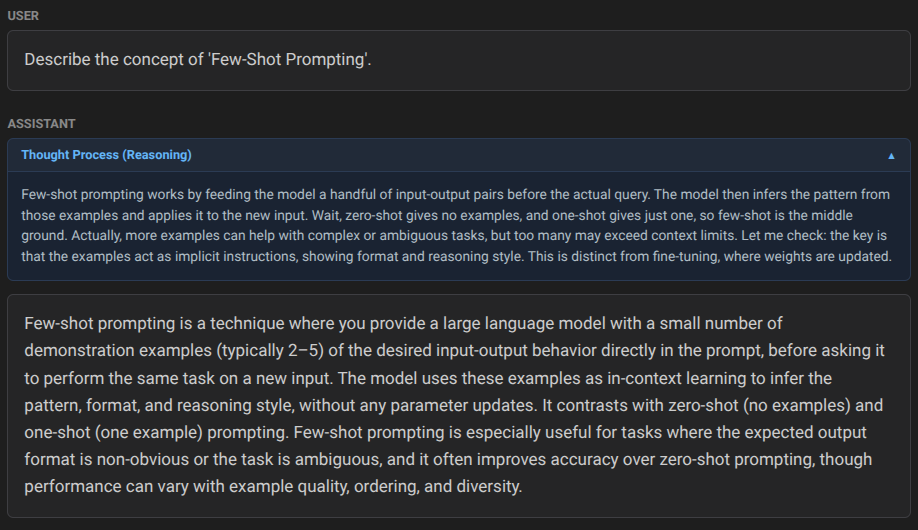
Here are two samples of the dataset:

Usage
You can load this dataset and finetune your model on it. We recommend a lower learning rate than in your pretraining and we recommend using an already instruction-tuned model as the base model for the finetuning. For epochs count, you can use around 2 to 3 epochs.
- Downloads last month
- 81